

VPS in Italy or Abroad, Differences in Latency and GDPR
When planning the launch of a new web application, a structured e-commerce store, or a company management system, comparing the price lists of various VPS hosting providers almost always leads to a crossroads. On one side, there are offers from foreign operators with massive data centers in Frankfurt, Amsterdam, Helsinki, or even overseas; on the other, there are domestic infrastructures. On paper, a virtual machine equipped with a given number of vCPUs and gigabytes of RAM looks identical regardless of where the physical rack is located on the map. In everyday practice, however, physical network geography and national legal jurisdictions weigh heavily on both service responsiveness and the legal responsibilities of data administrators.
Choosing between a VPS in Italy and a solution hosted abroad is not a matter of technological localism. Everything revolves around three very concrete aspects that we at Servereasy.it, working daily alongside system administrators, developers, and IT managers, measure in the field every day: the milliseconds it takes for packets to travel back and forth between client and server, the chain of custody of personal data under European regulations, and how quickly one can speak directly with data center engineers when support is needed.
How much geographic location really affects VPS latency
The speed of light in fiber optic cables has an insurmountable physical limit, compounded by the delays introduced by routing equipment along the way. When discussing VPS latency, we refer to Round Trip Time (RTT), which is the time expressed in milliseconds that a data packet takes to leave the user’s device, reach the server, and return with the response.
For a static website with just a few pages or an internal testing environment, having a ping of 12 milliseconds versus 45 milliseconds makes little difference. The situation changes completely as soon as dynamic databases, uncacheable user sessions, continuous API calls, remote SSH or Remote Desktop (RDP) connections, and VoIP telephony platforms come into play.
The path of data packets between the Milan MiX and international nodes
A user browsing from Rome, Turin, or Bari through an Italian telecom operator is routed almost immediately to Italy’s main internet exchange point, the MiX (Milan Internet eXchange). When a project runs on our VPS in the Settimo Milanese datacenter, connected directly to the MiX via our Autonomous System (AS60798) and with multiple uplinks to Tier-1 carriers, the data path is extremely short. VPS latency across the entire Italian territory thus stays within a range of 5 to 15 milliseconds, remaining below 30 milliseconds toward the rest of Western Europe as well.
Conversely, when the server resides in northern Germany, France, or the Netherlands, traffic from an Italian user must cross the Alpine backbones, pass through several international transit routers (increasing the number of hops), and enter foreign exchanges. Under normal conditions, this extends response times to 30-50 milliseconds, but during evening peak hours or congestion events on international routes, both delay and jitter (the variation in packet arrival times) can rise unpredictably. And if the data center is located in the United States, simply crossing the transatlantic submarine cables pushes baseline latency above 90-130 milliseconds.
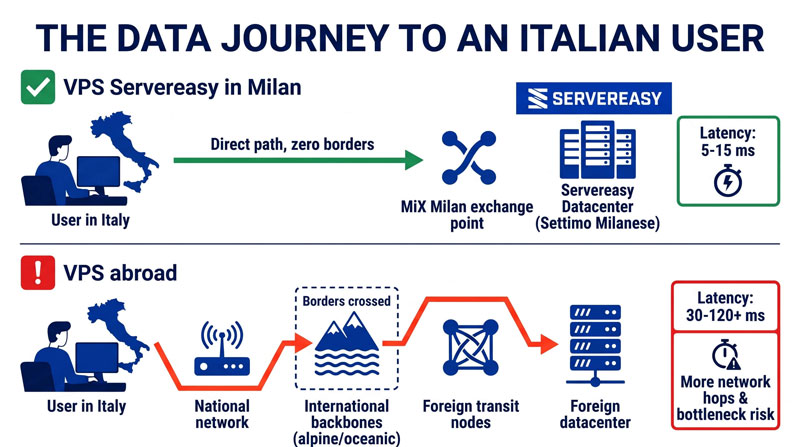
| Datacenter Location | Average IT Latency (RTT) | Average Network Hops | DB, APIs and Sessions |
|---|---|---|---|
| Italy (Milan / MiX) | 5 – 15 ms | Minimal (Direct peering with Italian ISPs) | Immediate response, instant loading |
| Central/Northern Europe (DE, FR, NL) | 25 – 45 ms | Medium (International Alpine transit) | Noticeable slowdown on multiple calls |
| North America (USA / Canada) | 90 – 140 ms | High (Transoceanic backbones) | Marked latency on checkout, RDP, and ERPs |
From ping to Time To First Byte on e-commerce stores and management software
Anyone working in search engine optimization and web performance knows well that network latency is not paid just once per page load. Before the browser can even receive the very first byte of the page (the metric known as TTFB, Time To First Byte), client and server must complete DNS resolution, the TCP three-way handshake, and TLS cryptographic negotiation. Each of these steps requires a back-and-forth exchange of packets.
An extra delay of 35 milliseconds each way, multiplied across the various negotiation cycles and sequential requests for scripts and AJAX calls, easily turns into hundreds of milliseconds lost before the page even begins rendering on screen. On an online store built on Magento, PrestaShop, or WooCommerce, where cart and checkout stages cannot be served by a static CDN because they rely on real-time processing by the origin server, a low-latency VPS in Italy helps keep Google’s Core Web Vitals metrics (particularly LCP and INP) in top shape, supporting both organic rankings and conversion rates. The exact same benefit is clearly felt by employees using cloud-based ERP or CRM software for eight hours a day, where interface responsiveness depends entirely on server proximity.
Servers in Italy, GDPR, and the data residency issue
Alongside network metrics, the second major dividing line between a domestic provider and a foreign one concerns the regulatory framework. In recent years, the Italian Data Protection Authority (Garante Privacy) and European authorities have significantly tightened rules around data transfer and storage, making the combination of servers in Italy and GDPR a priority for businesses, public administrations, software houses, and professional firms.
There is often a tendency to assume that simply selecting a “European Region” (perhaps in Frankfurt, Dublin, or even Milan itself) on the control panel of a major American cloud giant is enough to shield a company from any legal challenge. The legal reality, however, is more complex.
The difference between keeping drives in Europe and being subject to non-EU laws
There is a substantial distinction between physical data residency (the geographic place where hard drives are located) and data sovereignty (the law to which the legal entity owning and managing those servers is accountable). Major US hyperscalers, even when they open data centers on Italian or European soil, remain corporations governed by American law. As such, they are subject to the CLOUD Act (Clarifying Lawful Overseas Use of Data Act), a federal statute that allows US government authorities to request access to data held by US companies regardless of whether those files are physically stored in Italy or Germany.
We at ServerEasy.it are a company with entirely Italian capital and registered headquarters, and we store all our VPS instances and their respective backups exclusively within our Settimo Milanese datacenter. This structural choice eliminates any conflict of jurisdiction at the root: no copy of the databases ever leaves the national perimeter, and the entire contractual relationship, including the Data Processing Agreement (DPA), is governed solely by Italian law and European Union regulations.
Compliance management, backups, and security under European regulations
For organizations handling customer personal data or special categories of data (such as healthcare, legal, or financial records regulated by Article 9 of the GDPR), having a GDPR-compliant server in Italy with a certified domestic operator greatly simplifies maintaining the record of processing activities and conducting Data Protection Impact Assessments (DPIAs). Neither Standard Contractual Clauses (SCCs) nor complex verifications under the Data Privacy Framework are needed to justify transferring information to third countries.
Furthermore, Article 32 of the European regulation requires the adoption of appropriate technical and organizational measures to ensure the confidentiality, integrity, availability, and resilience of systems, along with the ability to restore access to data in a timely manner in the event of an incident. Added to these obligations are the even stricter requirements of the European NIS2 directive (transposed in Italy by Legislative Decree 138/2024), which requires companies in critical sectors and their digital providers to enforce rigorous security verification across the entire supply chain.
To provide objective guarantees documented by independent audits to our clients, we at Servereasy.it have certified our processes according to the most stringent international standards: in addition to the ISO 9001:2015 certifications for quality and ISO 14001:2015 for environmental sustainability, we hold the ISO/IEC 27001:2022 certification for information security, enhanced by the two cloud-specific extensions ISO/IEC 27017:2021 and ISO/IEC 27018:2020 (specifically dedicated to protecting personal data in cloud services), with an infrastructure already aligned with NIS2 Ready parameters.
Note on our solutions in the Milan data center: For projects that require low latency toward Italian users right from the start and the certainty that data remains within national borders, the page dedicated to our Cloud VPS in Italy lists all resource tiers ready for instant activation, featuring unlimited traffic and full compliance with European regulations.
When a virtual machine abroad makes sense and when it penalizes the project
It would be a stretch to claim that a virtual machine outside Italy is always the wrong choice regardless of context. There are specific scenarios where using a foreign datacenter is the most logical technical solution. If an Italian company develops an editorial portal or a mobile application aimed exclusively at the US, Canadian, or South American market, without collecting or processing European citizens’ data on that server, placing the VPS in New York or Virginia will reduce latency for local users. The same applies to anyone building a geographically redundant backup node thousands of kilometers away for extreme disaster recovery plans, provided that volumes are fully encrypted prior to transfer.
When the primary user base is in Italy or neighboring European countries, however, moving workloads abroad just to save a few euros a month exposes the project to technical and operational bottlenecks. Beyond the milliseconds lost on every HTTP request, an aspect often underestimated at the time of purchase is emergency management. Faced with a network or configuration issue in the middle of a workday, having to open tickets in English with a first-level call center located in another time zone extends resolution times. With our VPS in Italy, anyone needing support speaks directly with the system administrators of our NOC (Network Operations Center), who work hands-on with the machines in the Milan data center and know every piece of network equipment inside out.
What matters in a VPS hosting in Italy beyond datacenter proximity
Geographic location in Milan and regulatory protection form the starting foundation, but on their own they are not enough to guarantee performance if the physical node hosting the virtual machine is undersized. In the VPS hosting market, it is still common to come across platforms built on outdated shared-container virtualization technologies or plagued by heavy overselling, where dozens of customers compete for the exact same CPU cores and disk bandwidth, causing sudden speed drops during peak midday hours (the classic “noisy neighbor” effect).
KVM isolation, NVMe drives, and network DDoS protection
To prevent the advantage of low network latency from being offset by hardware wait times, we at Servereasy.it have built all our VPS solutions on full KVM virtualization through Proxmox VE. Every instance, whether configured with Linux distributions (such as Ubuntu, Debian, AlmaLinux, or Rocky Linux) or with Windows Server, has its own independent kernel and truly guaranteed computing resources.
From a hardware perspective, our nodes use latest-generation enterprise AMD EPYC processors paired with ECC RAM and storage arrays built entirely on NVMe SSDs configured in RAID 10. This combination delivers extremely high read and write speeds for the heaviest databases while protecting against data loss in the event of a single drive failure. To safeguard operational continuity, every plan on our VPS lineup natively includes automated daily backups (with 7-day retention always stored within our Italian datacenter) and our proprietary Always-On Anti-DDoS protection, developed in-house to filter both Layer 3 and Layer 4 volumetric attacks and application-targeted saturation attempts in real time.
The balance between network responsiveness, perimeter security, and legal certainty makes infrastructure selection a central step for any digital business targeting the Italian market. Within the section dedicated to our VPS Hosting solutions in Italy on Servereasy.it, all technical specifications for the Linux and Windows plans are available in full detail.
Servereasy Answers:
Does the server have to be located in Italy to comply with the GDPR?
The text of EU Regulation 2016/679 does not impose an absolute requirement to host servers within Italian borders, as it allows the free movement of data within the European Economic Area (EEA) and toward countries covered by specific European Commission adequacy decisions. However, keeping servers and backups in Italy with an Italian-law provider like ServerEasy.it shields the company from legal gray areas tied to non-European surveillance laws (such as the CLOUD Act for US-controlled providers) and simplifies legal management during inspections, privacy audits, or NIS2 directive compliance.
Is the speed difference between a VPS in Milan and one in Germany noticeable in daily use?
When opening a single static web page, a difference of around 20-30 milliseconds may seem negligible to the naked eye. The gap becomes clearly noticeable, however, across all operations requiring multiple, continuous exchanges between user and server: managing the back-end of a CMS like WordPress or PrestaShop, completing an e-commerce checkout, working in a remote session via SSH terminal or Windows Remote Desktop, and running frequent queries on company databases feel noticeably smoother and more responsive when traffic routes directly through the Milan MiX.
How important is Italian-speaking technical support when managing VPS hosting?
Whenever an unexpected issue arises or clarification is needed regarding a virtual machine, language barriers and time zone differences typical of many foreign providers can lengthen response times. By working with us at Servereasy.it, communication always takes place in Italian and during the same business hours, speaking directly with our technical team that knows and manages the Milan infrastructure firsthand, without going through intermediate call centers.

Our mission is to provide scalable, secure, and consistently reliable hosting and IT infrastructure solutions tailored to both individuals and businesses.
We believe hosting should be simple and transparent; that is why we invest in cutting-edge technologies and proprietary protection systems, ensuring performance and continuity in any situation.
With over 15 years of experience, we support our clients’ digital growth through expert assistance and constant innovation.
www.servereasy.it